
The Power of Language in Understanding Ourselves: A Journey Through Art

Updated: Sep 2
Exploring Fragmentation and Wholeness
There is a difference between describing a person and defining one. Throughout our lives, we accumulate language that does not originate with us. Teachers evaluate our abilities. Doctors describe our symptoms. Psychologists interpret our behaviors. Social workers write case notes. Researchers reduce human experience into measurable variables. Each discipline has its purpose. Yet, I often wonder what happens when these borrowed words become the framework through which we begin to understand ourselves. This artwork emerged from that question.
At first glance, the piece appears fragmented. Typed passages from psychology and statistics intersect with rough pencil sketches, partially erased handwriting, neurological diagrams, and the repeated word “deficits.” It feels unfinished, almost as though it is still thinking. That was intentional. I wanted the surface to resemble the mind itself—not orderly or complete, but layered with memories, observations, interruptions, and revisions.
The Language of Objectivity
The composition begins with the language of objectivity. Scattered across the page are references to measures of dispersion, emotional theory, and labeled regions of the brain. These fragments belong to science and academia. They represent our desire to understand human behavior through observation, measurement, and classification. There is tremendous value in this work. Research has expanded our understanding of trauma, learning, memory, and mental health in ways that have transformed countless lives. Yet, science is only one language.
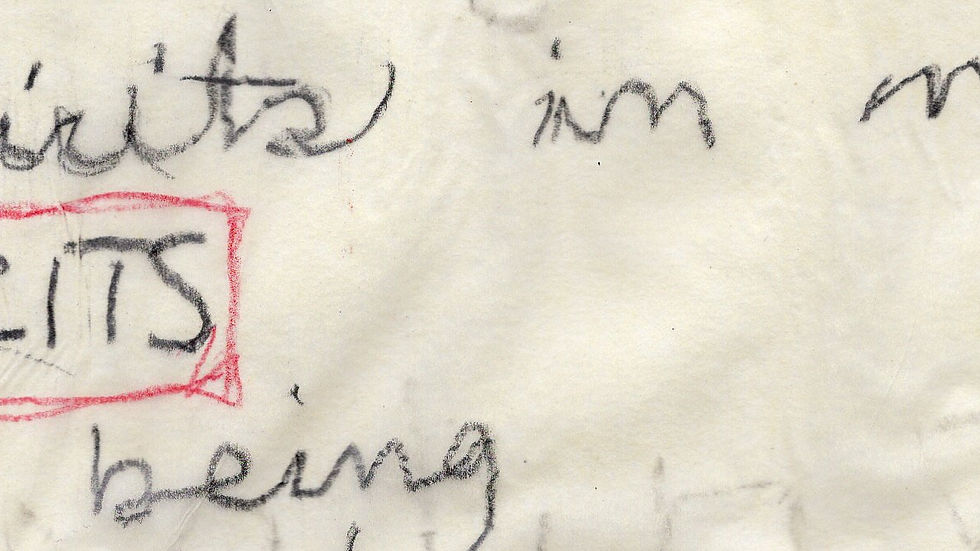
Running through these clinical references are handwritten words that refuse the neatness of the printed text. Scribbled phrases overlap diagrams. Some thoughts are erased before they are fully formed. Others remain faint, barely visible beneath later marks. The page becomes less like a research document and more like an archaeological site where traces of thought remain long after certainty has disappeared.
The Weight of Deficits
Perhaps the most striking word is “deficits.” It appears repeatedly, boxed, rewritten, emphasized. In educational settings, child welfare systems, psychological evaluations, and even everyday conversations, people are often introduced through what they lack before anyone asks what they possess. We speak of deficits in attention, deficits in behavior, deficits in emotional regulation, and deficits in academic performance. These descriptions may serve practical purposes, but they also carry tremendous psychological weight.
Eventually, a deeper question emerges:
At what point do the words used to evaluate us become the words we use to evaluate ourselves?
That question sits at the heart of this work. The faintness of the handwritten text also matters. Much of it resists easy reading. Some viewers have asked whether the marks should be darker or more legible. I believe their ambiguity is essential. Trauma rarely presents itself as a coherent narrative. Memory is incomplete. Identity is constantly revised. We often remember feelings before facts, impressions before chronology. The viewer must search for meaning because healing often requires the same effort.

The Brain and Its Complexity
Near the bottom of the composition rests a simple drawing of the brain. It is not anatomically precise, nor is it intended to be. Instead, it serves as a quiet reminder that no diagram can fully capture consciousness. We have become remarkably skilled at mapping neural pathways and identifying regions associated with memory, emotion, and executive functioning. Yet knowing where an experience occurs is different from understanding what it means.
There is another detail that continues to interest me. The typed text states: “The emotions are by-products of more fundamental events.” Placed beside handwritten reflections and personal markings, the sentence becomes something more than a scientific observation. It raises an important tension between biology and lived experience. Our emotions may emerge through neurological processes, but they are also shaped by relationships, institutions, labels, stories, and memory. The brain never exists in isolation. It develops in conversation with its environment.
The Significance of Color
That is why the sparse use of red throughout the piece feels significant. Red surrounds the word “DEFICITS.” It appears again in the notes and along the lower portion of the brain. Rather than functioning as decoration, the color becomes interruption. It marks the places where objective language collides with subjective experience—where diagnosis becomes identity, where observation leaves an emotional imprint.

Language as a Reflection of Identity
The longer I spent with this work, the less it became about neuroscience and the more it became about language. Not simply the words we speak, but the words spoken over us. Every person inherits descriptions from somewhere. Some are affirming. Others are limiting. Some become encouragement, while others quietly settle into identity until they feel indistinguishable from truth.
This piece asks us to pause before accepting every borrowed description. Because we are more than assessments. More than diagnoses. More than reports. More than data. More than the margins of a case file.
If there is one hope I have for viewers, it is that they leave asking themselves a single question:
How much of what I believe about myself was discovered—and how much was assigned?
That question does not reject science, education, or psychology. Instead, it invites them into a larger conversation. Human beings deserve to be understood through evidence, but they also deserve to be understood through story, imagination, resilience, and possibility.
The Journey of Healing
Perhaps the most meaningful work we will ever do is learning to distinguish between the language that was given to us and the language we choose to carry forward. Healing may begin the moment we realize that not every borrowed word belongs in the story we continue to write.
As we navigate our journeys, let us embrace the complexity of our identities. Let us acknowledge the layers that shape who we are. Each experience, each word, and each moment contributes to our understanding of ourselves.
Through art, we can spark dialogue and reduce stigma surrounding mental health. We can foster understanding and healing around complex social issues like trauma and addiction.

Until next time,


Comments